Tuesday, May 29, 2012

What's in a Name?

We all know that names are important. We love our name or hate it enough to change it once we reach legal age. Women are less willing than their grandmothers to change their last names when they marry, hence the advent of the hyphenated surname. 

I have told people that I don't name my cats, they tell me what their name is. On occasion I've named a cat only to change it later when the cat subtly let me know his displeasure.

It's the same with characters in books. Sometimes the name comes into my head immediately. Other times I have had to search long and hard for the right name. One of my favorite places to find an unusual but apt name is in the obituaries. Of course, I don't take the entire name and plop it in my book, I am as averse to being sued as the next writer. I mix and match.

Baby name sites in the Internet are good because they give you the meaning of the name. Do you want your character to be manly? a leader? wise and good? You can find appropriate names here.

And, at a pinch, I turn to the telephone book.

The lead character in my current WIP is named Marcie. I wanted her to be kind and sympathetic, almost to a fault. Mercy would be too obvious, but Marcie--I hope--leads the reader to subconsciously translate this quality from her actions. The male hero is Adam Shepherd. He's a minister. 'Nough said.

A secondary character is named Moon. It isn't a nickname, Moon was born in the sixties of a Flower Child mother named Light. She called her three daughters Sun, Moon and Star. When Moon complains that Sunny and Star got the best of the deal, while she was always subject to teasing, she is asked why she doesn't change it.

"Because it's my name," she says incredulously.

That's one that popped in my head. Maybe as I revise it will be abandoned. Or maybe not.

One name I had to change was Beth's husband, Dan, in "The Lunch Club". I originally called him Dave. Then I  realized that was the name of the main character in Linda Evan's Book, "Jobless Recovery." Both Daves are out of work. My Dave was older and married, but I still felt badly about stealing her name. So I changed it. Dan will always be Dave to me, though.

How do you come up with names for your characters? Do they pop into your head or do you spend hours finding just the right one?

Remember, Margaret Mitchell originally called Scarlett O'Hara "Pansy." Would a Pansy have sailed virtually unscathed through the Civil War?

I think not. And neither did Mitchell.


Tuesday, May 22, 2012

Meet Beth

Introducing Beth, the fourth member of "The Lunch Club." Dan's refusal to face the reality of the job market has led to yet another fight.


 “When are you going to stop being mad at me—and everything else?”
“What makes you think I’m angry?” His tone was level, but his eyes told another story.

“You are. And you know what? I don’t want to live like this anymore.”

After a long silence, Dan asked, “What are you going to do?”

“Oh God, I don’t know. Get a job, like Bobbi said. At least I’d be out of the house.”

Dan snorted. “Like getting a job would be easy. Haven’t you seen how hard I’ve been trying? Your degree is in library science and you haven’t worked since we moved to North Carolina. Good luck with that.”

Beth drew a long breath. “First of all, I’d be realistic. I’ll search for something available, like a sales clerk or receptionist. And I won’t make the mistake of turning my nose up at a job because it doesn’t have the cachet of say, a plant manager.”

“So you think some perverted kind of snobbery is my problem? I won’t take available jobs because they’re below my dignity?” He spoke without inflection, which frightened her a little.

“That’s what I think, yes.”

“So—I should go into the nearest pizza place with a sign out front saying they need drivers and go in and apply?”

“Why not?”

“You know what they pay?” He sounded both amused and incredulous.

The danger past, she relaxed and essayed a joke. “No, but I bet you’d get lots of free pizza.”

When Dan didn’t reply, Beth stood. “I’m going to bed now.” She left without waiting for him to follow.

After a few minutes, she heard him pad down the hallway. She continued dabbing on her night cream. Dan’s face loomed behind her in the mirror, like a rising moon. He watched her for a few minutes, his face devoid of expression as an egg, and then backed out, leaving her alone.

She hadn’t expected an apology—Dan never apologized—but he could at least have offered a civil “Good night,” Beth thought. She felt her eyes sting with tears. It had been so long since he had kissed her goodnight or even offered a hug. Sex wasn’t even on the horizon.

She picked up her brush drew the plastic bristles through her hair, hoping to prevent the inevitable snarls that appeared during the night. She tried to understand Dan’s reaction to her revelation that she had enjoyed her night out. He not only acted like he didn’t care, he acted like he would have been happy if she said she was leaving him. Are you going to see him again? A few months ago, the statement would have been ludicrous. Now, it showed how far they’d drifted apart.

Maybe he was tired of her. Maybe she was the symbol of his failure, and he hated looking at her, reminded of the man he’d been. Feeling old, ugly and unloved, she threw the brush down on the sink edge, not caring if the handle cracked.

Friday, May 11, 2012

Meet Melody


You have met Harriet and Jane Anne of "The Lunch Club". Today you will meet the third member of the group, Melody. As the scene opens, Melody now feels comfortable with the man she met on the Internet  and has invited Tony to her home for dinner. They have enjoyed a home-cooked meal and are settling down to watch a movie.

The book cover you see is the mock-up of the proposed cover for "The Lunch Club." What do you think? I love the colors. 
                                       
                                               ***
They cleared away the remnants before starting the movie Melody picked out, Leatherheads. Melody assumed Tony would like the sports theme, and she liked George Clooney. But she didn’t have to tell Tony that.

As the movie neared its finale and the approach of the second hurdle of the evening, Melody got more and more nervous. She’d planned what to say over and over during the last few days, but now the time was here, she wasn’t sure how her proposal would be received. She forgot her fears when Tony’s arms slipped around her shoulders and his lips met hers. After a few kisses, his fingers touched her breast. Melody’s hands found their way to his shoulders, and then his body melded into hers, legs entwined. Somehow, his hand now touched bare flesh. They realized they were on the edge of a precipice. Tony pulled away first.

“I guess I’d better go,” he said, his dark eyes shadowed with desire.

“You don’t have to,” Melody said, knowing the same longing was reflected in her eyes. “It’s a long drive back to Charlotte and it’s late. You should stay here and go in the morning.”

Tony looked at her for what felt like an eternity, but was in reality a few ticks of the clock on the mantel over the fake fireplace. “You have a spare bedroom?” he asked.

“Yes. But that’s not what I’m saying.”

“You’re sure?” Both knew what he was asking.

“Very sure,” Melody said. “I keep a fresh toothbrush in Charlie’s bathroom, and toothpaste. And Charles’ shaving kit is there, too. And towels,” she added, remembering another inducement.

 “All right, then.”

She smiled. “I’ll go and put on my nightgown while you change. There’s a robe, there, too.”After he left, Melody allowed herself to sag in relief. He hadn’t acted as if she were some kind of wanton woman, throwing herself at him. He’d been the gentleman she’d come to expect. Then she smiled. There was one more thing she’d placed in the small bathroom. She hoped he’d notice the condom. She hadn’t fallen off the turnip truck yesterday. She knew if she slept with Tony tonight, she’d be sleeping with every woman he’d ever slept with, and their partners, too.

By the time she’d changed into a simple sleeveless cotton gown, Tony stepped into the bedroom, wearing Charlie’s old blue robe. He smiled and shook his head at her. “Everything a man could need,” he said. She laughed and held out her arms.

Wednesday, May 2, 2012

"The Lunch Club" -- Jane Anne

A few weeks ago I introudced Harriet, a member of  "The Lunch Club" (coming soon from Draumr Publishing). Today, I would like you to meet Jane Anne. In this excerpt, Larry and Jane Anne are in the car when Larry almost has an accident. Jane Anne wonders how she can insist on taking the wheel without causing a scene:

To her relief, when they reached the car he got in on the passenger side. “I’m not driving anymore,” he said. He handed her his keys. “Here. Throw them away or something.”


She took them and dropped them in her purse. Thank you, God, she prayed. She’d thought she’d have to get Kris and Karen together and talk him out of driving, but he had seen for himself he wasn’t responsible. Of course, he might forget by tomorrow and want his keys back, but she’d handle that when and if the situation arose. She started for home, wondering how a day that started out so promising could go bad in a few short hours. Larry sat and stared out of the window. She didn’t know what he was thinking.

Once home, she shooed Larry into the living room so she could put away the groceries and start supper. When she put her casserole in the oven, she sat at the kitchen table, not wanting to join him yet.

She thought back to when they met. Larry taught a required course in Romance poets and she decided three weeks into the semester she was going to marry him. She was a junior with two years to go before she graduated. There were rules against a professor dating a student, so she bided her time, garnering every scrap of gossip about the handsome bachelor professor. Every time his name was linked with this or that woman her heart sunk. But then, weeks or months later, the rumor would go around they had broken up, and Larry would be free once more.

On the day of her graduation, she excused herself from her parents, who had driven over a hundred miles to see their only child receive her diploma, and gone to Larry’s office.

“I want to take you to dinner tonight,” she’d said.

He’d looked up in bewilderment. Then he’d shrugged. “Why not?”

Later, she decided Larry was too unmotivated to court any of his lady friends with any serious intent and so they gave up hope and moved on. Her daring pursuit had intrigued him.

She’d marched back to her bewildered parents and told them instead of following them home in her tiny VW she was going to stay and find a job near the college. She’d soon found out a degree in English literature opened no doors, so she took a job waiting on tables at O’Hanrahan’s, a bad imitation of an Irish pub. She and Larry married in the fall.

She quit her job and enrolled at Remount Community College where she earned an associate degree in medical record keeping. Upon graduation, she’d taken a position at Remount Community Hospital and gotten pregnant with Karen, in that order.

Surprisingly—not to Jane Anne, but to everyone else—they had been very happy. Every year on their anniversary he thanked her for yanking him out of his academic rut and showing him what life could be. He adored his children, and he adored her. Now, she had to ask herself if it had been worth it.

She sat there until the timer buzzed, jolting her out of her reverie. Then she walked into the living room to call her husband for dinner.


Tuesday, April 24, 2012

In Good Company

Our Carolinas Writers Conference is now in the past. It took a year of planning to set up the event and like most milestones, it was over too quickly. We are already in the planning stage for 2013. (You can see photos of the event at ansoncountywriters'club.org

My writing partner, Elbert Marshall, and I were asked to do a session on "How to Co-Write a Book Without Committing Homicide." We are the authors of "Plotz," a pyschological suspense novel.

In addition to being a presenter, I also had the opportunity to attend a couple of sessions. I especially enjoyed Marjorie Hudson, author of "Accidental Birds of the Carolinas." After reading her book, the committee unanimously decided to ask her to talk about using the five senses in writing. She writes wonderfully descriptive stories and her workshop made me determined to describe more accurately what my characters are tasting, smelling and touching along with seeing and hearing.

Tony Abbott's presentation was a joy. I had met him eons ago at a workshop at Duke University and purchased "The Girl in the Yellow Raincoat" then. What a pleasure to hear that poem again, and some of his more recent poems. Those who attended his workshop are still talking about it. Only a few lucky ones were able to have him critique their poems, but they all said it was one of the best workshops they'd attended. Ever.

I really enjoyed Margaret Maron's talk. I could relate to Ms. Maron in so many ways. Like me, she wrote short stories and poetry before writing a novel. She admitted that it took her a long time to start writing because she didn't feel as if she had anything to say. I almost jumped up and yelled, "Me, too!" And, like me, her novels are set in an imaginary North Carolina town. Her books are mysteries; mine are not, but both our works are character driven.

The highlight for me was when I was told I was sit in on the panel discussion. I didn't feel I belonged in a group of distinguished authors and publishers, but took a seat anyway. It was a lot of fun and made me feel that I had "arrived" even though I can claim only two books published, and one coming up.

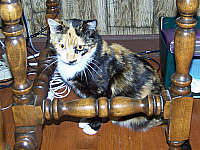
Oh -- the photo? That's my cat, Spooky. She lives under the computer desk. Every writer needs a cat and she graciously agreed to be mine.

Tuesday, April 17, 2012

The Importance of being Accurate


Whew! It's been a busy few weeks, but I'm back. The 4th annual Carolinas Writers Conference is now history. It began Friday evening with Back Porch Stories: ghost stories, Native American stories and just plain "growin' up Southern" stories.

On Saturday, Margaret Maron gave the morning address, with another talk by poet Anthony Abbot after lunch. In between were sessions on any aspect of writing you could wish to attend. I learned a lot about the craft of writing and I think other people did as well.

Then, a complete change of pace on Monday. I am a member of the DAR (Daughters of the American Revolution). We have a small chapter because, frankly, younger women don't seem to have the passion for history that my generation does.

Years ago, in 1928, the original two Anson County chapters got together and placed a bronze plaque on "Execution Rock" to mark the grave of Wadesboro's founder, Col. Thomas Wade. Execution Rock is where the Catawaba Indians beheaded their enemies and was said to weep blood every time it rained.

This rock is 50 yards from the the site of the first courthouse in Anson County. Perhaps Col. Wade wanted to be buried there because, being a local point of interest, the site would always be easily identified.

Some 160 years later, people were beginning to forget the rock's significance
and it was necessary to add a cast bronze plaque to remind them of its historical importance.

Fast forward another 80 years and the site is now farmland, and privately owned. Even if you know about Execution Rock, you can't just go see it; you have to get permission from the owner and then you have to find it.

The rock was largely forgotten until a local historian visited the site and discovered that the numbers for the date of death had been transposed. Instead of 1786, the marker read 1768. He came to the DAR and strongly suggested we fix it. After all, it was our error. Not that any of us were around then.

The members consulted a funeral home -- we figured they would know about plaques and monuments -- and found that to either recast the original bronze plaque or order a new one was prohibitively expensive. An alternative was suggested: add a new marker with the correct date. This, being more in line with our treasury, was the route we took. The new stone says simply, "“Corrected Date of Thomas Wade’s Death is 1786. Placed by Craighead-Wade Chapter DAR 2012.”

Several of us went to the site to see the new marker placed beside Execution Rock. We drove a long, bumpy dirt road, met the man who could open the gate, and followed his pickup along another bumpy, dirt road. Then we walked across the field, weaving our way through brittle cotton stalks with bits and pieces of cotton still clinging to them.

We kept a wary eye out for snakes. The area is said to be a favorite haunt of rattlers. We didn't see any, but I'm willing to bet some were there, wondering why all these humans were disturbing their afternoon sunbath.

We took pictures to commemorate the event and the new, laser-engraved slab was placed in a bed of concrete. Satisfied that history had been served, we retraced our path and went home.

Now, I know that very few people remember where this boulder is. If I didn't have directions written down, I'd never find the place again. Moreover, you need permission from the owner to go there. So the likelihood of anyone seeing the new plaque is as remote as the site itself.

Why did we do it? Because we wanted the wording to be accurate. Too much of our history is being distorted, lost or ignored. Both markers are constructed to last for years, if not centuries. That field may not always be farmland. In the event that years down the road the marker is rediscovered, we wanted the finders to know that long ago, there was a group of women -- and one determined man -- who wanted our history be recorded accurately.

In stone.

Friday, March 30, 2012

Where Ideas Come From: Part II


Most writers sooner or later hear the question: "Where do you get your ideas?" I addressed that in another blog (Dec. 4, 2011), but that addressed one book and one idea source.

So if an idea doesn't conveniently pop into your head, or you have a character in search of a plot, what do you do?

We all know that change can affect us in an instant. A telephone call, a doctor's diagnosis, the screech of brakes--and a life is changed irrevocably, forever. From now on, everything will be divided into life "before" and life "after."

Change your heroine's life is some tragic manner and then help her climb out of the pit and start over again. If you write romance, give her a stalwart and handsome guy to get her to her HEA. (If you don't know what that means, you don't write romance.)

You can have your character make a seemingly innocent decision that leads to consequences she (and the reader) never see coming. (Peter Taylor was a master of this technique.) Like a line of dominoes, that decision affects another and another until she's at a place she never expected to be.

This can be fun if it turns out to be a place she declared vehemently at the beginning of the story that she most definitely would never be. Will she have grown throughout the story to realize this is where she was meant to be in spite of her declaration, or will she end up bitterly reflecting on that one time she took a path from which there was no returning?

One of my favorites is "What if?" Think of a situation and its logical outcome and then ask yourself, "What if the heroine did something unexpected instead?" This is akin to the fateful decision, but different in that this time she consciously makes the choice and faces the consequences.

The "What if?" can also be an external force. In "Angels Unaware," Kat expects her husband to stand by her when she learns she has cancer. Wouldn't most husbands? But what if Jordan has no stomach for sickness, and he walks out? It's a combination of the tragic circumstance and an unexpected reaction.

I used all of the above to move my four characters in "The Lunch Club." There are tragic events. There are fateful decisions that have unexpected consequences. And over them all are the words "what if" as the characters pick themselves up and decide what to do next.

All of them find love--new love, renewed love and strengthened love--that leads them to their HEA.

Oh--"Happy Ever After."

Wishing all of you a blessed Easter season and the joys of springtime and renewal.